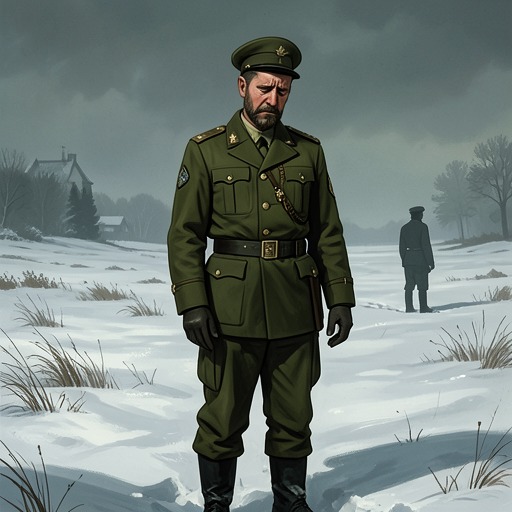
Miller’s bond with his pilot brother and years-long search
Operation NapoleonMiller’s bond with his pilot brother gives the concealed wartime mission its intimate human cost: a brother who thought he was arranging a safe journey instead helped send his closest family member into an operation neither of them understood. Their weekly letters sustained the relationship across separate postings; the crash ended their hoped-for reunion, and the discovery of the body years later gave Miller an answer without undoing the loss.
A bond maintained by letters and brief meetings
Miller and his brother joined up in December 1941, in the immediate wake of Pearl Harbor, but the two were assigned to different services and had no say in where they were posted. Miller went to army intelligence headquarters in Washington, D.C.; his brother joined the air force and was sent around Europe. His flying took him over Iceland and Greenland and later on missions from bases in Britain and Italy. The brothers’ lives therefore diverged geographically even as the war gave them a shared frame of reference.
They met only twice during the war: first in London, then in Paris, where Miller gave his brother the assignment that would lead to the fatal flight. Their more regular connection was correspondence. They wrote throughout the war, exchanging news of their movements and looking forward to being together again after it ended. Miller later described the letters as a habit through which they tried to explain to themselves what they were witnessing. The correspondence was not merely a record of changing postings; it was how the brothers kept a common life in view while serving far apart.
The assignment that became a family tragedy
Miller’s brother was selected for a mission requiring an Allied pilot familiar with the route and able to make contact with Allied air traffic-control centres. He knew the route so well that Miller believed he could fly it blindfolded. Miller put forward his name, thinking he was acting in his brother’s best interests. The plan appeared straightforward: fly to Iceland, cross the Atlantic, meet in Reykjavík, and continue to South America for a few days’ leave, away from enemy aircraft and anti-aircraft defences. To Miller, it offered a safe interval together before the war’s expected end.
The gap between Miller’s understanding and the mission’s actual purpose is central to the tragedy of their relationship. The operation was compartmentalized: Miller received only partial information and did not know who had originated the plan, which army division had formulated it, or the ultimate purpose of the flight. The original plan to use an Allied aircraft in German possession was abandoned in favour of painting a Junkers Ju 52 in Allied colours. Miller was following orders, unaware of the concealed agenda and of the talks that lay behind the assignment. His brother, too, did not know the real purpose of his journey. Miller intended to explain it when they met, but the meeting never came.
The disappearance and Miller’s search
Miller arrived in Iceland with two other intelligence agents two days before his brother was scheduled to fly the German delegation from Berlin. They stayed at Hotel Borg, kept a low profile in a Reykjavík crowded with U.S. servicemen, and checked the facilities at the aerodrome in Vatnsmýri. The plane was expected to stop for three hours to take on provisions and refuel before continuing west. Although the forecast was initially fine, the season made the weather uncertain.
The meeting in Berlin ran late. By the time Miller’s brother took off, a deep low-pressure system was moving towards Iceland, bringing forecasts of snow and poor visibility. Air traffic control in Prestwick last contacted the plane four hours after it left Berlin, when it was north of the Scottish coast. Then news stopped. Miller was informed when contact was lost and immediately feared the plane had crashed. He waited at an airfield hangar, imagining that his brother might have gone down at sea or turned back towards Scotland and survived somewhere beyond reach. He held on to the possibility that his brother would emerge from a wilderness and find an outpost of safety, but that hope was not fulfilled.
When reports from Höfn described a plane flying so low that it must have crashed on Vatnajökull Glacier, Miller was appointed to lead the rescue mission. He had been unable to bear the prospect of returning to Washington without learning his brother’s fate. The search was made harder by winter conditions: flying was impossible, rivers and glacial outwash plains blocked the southern route to Höfn, and the northern route meant difficult travel and days lost to snowdrifts. Miller’s effort to find his brother was thus both an official rescue mission and a personal refusal to leave Iceland without an answer.
Recognition, loss, and belated knowledge
When Miller eventually inspected the body bags with Kristín, he found his brother in the last one. Kristín lowered the zip and handed Miller a torch; he bent over the body, studying the face. His whispered expression of recognition marked the end of the search, but not a reunion in any living sense. The body, a young man’s face drained of colour, had been preserved without a visible scratch. The glacier had kept him intact while making the passage of time unmistakable.
Miller had hoped that his brother might have left personal words behind. They had exchanged weekly letters throughout the war, and Miller wondered whether a message or a few final thoughts might have survived the crash. None had been reported. The absent message sharpens the contrast between the brothers’ habit of explaining their experiences to each other and the silence at the end of the mission. Miller could identify his brother and bring the search to its conclusion, but there was no final letter to answer the questions that had accumulated over a lifetime.
Only later does Miller disclose the deepest secret bound to the assignment: his brother was supposed to fly Adolf Hitler, who was to be accompanied by his German shepherd, Blondi. Miller’s brother had not been told the journey’s true purpose, and Miller had planned to tell him in person. This revelation recasts Miller’s act of recommending him as an ordinary expression of familial care made consequential by a clandestine plan. Their relationship is defined not by deliberate betrayal but by withheld knowledge: Miller’s brother trusted the assignment he was given, while Miller trusted that he was arranging a safe journey. The search brings the brothers’ wartime story back to the body in the bag, but the secret explains why the flight mattered and why the reunion Miller expected never took place.